 Nevernevermore
 / Why resolutions fail
Why New Year's resolutions fail
The most quoted statistic about New Year’s resolutions is a misread of a study about quitting smoking. The research it came from found something far more interesting, and more useful.
Almost every page written about this repeats the same statistic: eighty percent of New Year’s resolutions fail by February. It is on wellness sites, in newspapers, in the marketing copy of apps that would like to sell you the solution. Hardly any of them say where it came from.
We went and looked. The number is wrong in three separate ways, and what the research actually found is close to the opposite of the story built on top of it.
Three things wrong with the famous statistic
The number is a misread of a study about smoking
Claim: 80 percent fail by February
The trail leads back to work by Norcross and Vangarelli published in 1989, in which roughly a third of the participants were trying to quit smoking. Addiction has a relapse profile unlike learning the guitar, so the sample was never representative of resolutions in general.
More importantly, the low success figure usually quoted comes from a two year followup. At six months, the same work put success closer to forty percent. A number measured across two years is being presented as a number measured across six weeks.
Quitter’s Day is a marketing invention
Claim: everyone gives up on the second Friday in January
Quitter’s Day is a coinage, popularized by a fitness company reading its own app data about when activity drops. It is a real observation about a particular app’s users in a particular January. It is not a finding from any of the academic studies it gets attached to.
The study most often cited beside it, Richard Wiseman’s resolution experiment, tracked about 3,000 people across a whole year and found that 88 percent did not keep their resolution over that year. It did not measure the second week of January and says nothing about it.
The most-cited source is itself miscited
Claim: Richard Wiseman, University of Bristol
Wiseman is a professor of psychology at the University of Hertfordshire. Wikipedia’s article on New Year’s resolutions attributes the study to the University of Bristol, and a long tail of pages has copied it, including at least one that cheerfully says it got the fact from Wikipedia.
It is a small error and it does not change the finding. It is worth pointing at anyway, because it shows how this entire corner of the internet is written: by copying the page above, which copied the page above that. The statistic you have read fifty times has, in most of those fifty cases, never been checked by anyone.
What the research actually found
The cleanest study on this is not about failure at all. In 2002, Norcross, Mrykalo and Blagys did something most coverage never mentions: they added a control group.
They took 159 people who made a New Year’s resolution, and 123 people who wanted to change the same kind of thing but chose not to make a resolution, and followed both groups by telephone for six months.
46% vs 4%
Still continuously successful at six months: people who made a New Year’s resolution, against people who wanted the same change and did not make one.
Norcross, Mrykalo & Blagys, 2002
Making the resolution made people more than ten times more likely to actually change. Not because January is magic, but because naming a thing and fixing a date is itself an act with consequences, where wanting it is not.
That is the finding that got lost. The internet took a study about how hard change is and turned it into a story about how resolutions are pointless, which is the one conclusion the data does not support.
It erodes. It does not collapse.
The same paper tracked the shape of the decline, and the shape is the useful part. Self-reported continuous success went from 71 percent at two weeks to 46 percent at six months.
There is no cliff. Nothing in the data looks like the second Friday in January, or like February, or like any single moment where it ends. It is a slow leak, and it is a slow leak in both directions, because people who stop for a while are not necessarily finished.
This matters more than it sounds. If you believe in the cliff, then the first missed day is evidence that you have fallen off it, and that belief is what ends far more attempts than the missed day itself ever would. It is also why an app built around a streak is working against you here: a streak counter is a machine for manufacturing the cliff.
What separated the people who kept going
The 2002 study looked at what successful resolvers did differently, and the answer is unglamorous.
Before January 1, three things predicted success: self-efficacy, having the skills to make the change, and readiness to change. After January 1, successful resolvers used more cognitive and behavioral strategies, and fewer awareness-generating and emotion-enhancing ones.
In plainer words: the people who succeeded were doing things, not feeling things. They had concrete methods. Substituting one behavior for another, changing their surroundings so the right thing was easier, having a plan for the specific situation where it usually went wrong. The ones who leaned on motivation, insight and emotional intensity did worse.
Which is awkward for January, because January is an entire month of motivation, insight and emotional intensity.
So why do resolutions actually fail?
Not because people lack willpower, and not because January is the wrong month. The common pattern in the evidence is simpler: the resolution names an outcome, and nothing ever converts it into behavior.
“Get fit” is a direction. It is not a plan, and it cannot be done on a Tuesday. Somewhere between December 31 and the first week of January, somebody has to decide what get fit means this month, which thing happens first, and what specifically to do tomorrow given the forty minutes that actually exist. Most people never do that, because it is genuinely hard and because nothing in the tradition asks for it.
The research backs the shape of this. Approach goals, framed as something to start, outperform avoidance goals framed as something to stop. Small measurable targets outperform vague ones. Both of those are findings about specificity, which is another way of saying that the work is in the translation.
What to do with that in January
Keep the resolution. The evidence is clear that making one beats wanting the same thing without one, and by a wide margin.
Then do the part the tradition leaves out. Turn the outcome into a sequence: what has to be true first, what follows it, and what the first actual mission is. Frame each piece as something to start rather than something to quit. Size tomorrow to the time tomorrow really has, not to the time January 1 imagines you will have.
And decide in advance what a missed day means, because you will have one. The data says a missed day is not the cliff. Treating it as one is the thing that turns an erosion into an ending.
That translation, from an outcome into an ordered path and then into today’s specific missions, is what we built Nevernevermore to do. We would rather tell you that having shown you the evidence first.
Where these numbers come from
- Norcross, J. C., Mrykalo, M. S., & Blagys, M. D. (2002). “Auld Lang Syne: Success predictors, change processes, and self-reported outcomes of New Year’s resolvers and nonresolvers.” Journal of Clinical Psychology, 58(4), 397–405. The 46 percent and 4 percent figures, and the decay from 71 percent at two weeks, are from this paper. 159 resolvers and 123 nonresolvers, followed by telephone for six months.
- Wiseman, R. (2007). The resolution experiment, run through Quirkology and often called the New Year’s Resolution Project. About 3,000 participants tracked across a year, 88 percent of whom did not keep their resolution, with 52 percent confident of success at the outset. Wiseman is at the University of Hertfordshire. Wikipedia places him at the University of Bristol, and a great many pages have copied that.
- Norcross, J. C., & Vangarelli, D. J. (1989). “The resolution solution: Longitudinal examination of New Year’s change attempts.” Journal of Substance Abuse, 1(2), 127–134. The source of the much-repeated figure that most resolutions fail, including the two-year followup the 80 percent claim is usually drawn from.
- “Quitter’s Day” is a marketing coinage for the second Friday in January, not a finding from any of the studies above.
What these studies cannot tell you. Participants chose to take part and reported on themselves, with no independent verification. The authors of the 2002 paper say plainly that self-reported success rates are likely overestimates. Treat every number here as the best available evidence rather than as a measurement.
See it
One goal in. A quest out.
Tell the Raven a goal and it draws your whole path. Every morning, a sealed envelope of side quests sized to the time you have. These are the real screens, start to finish.
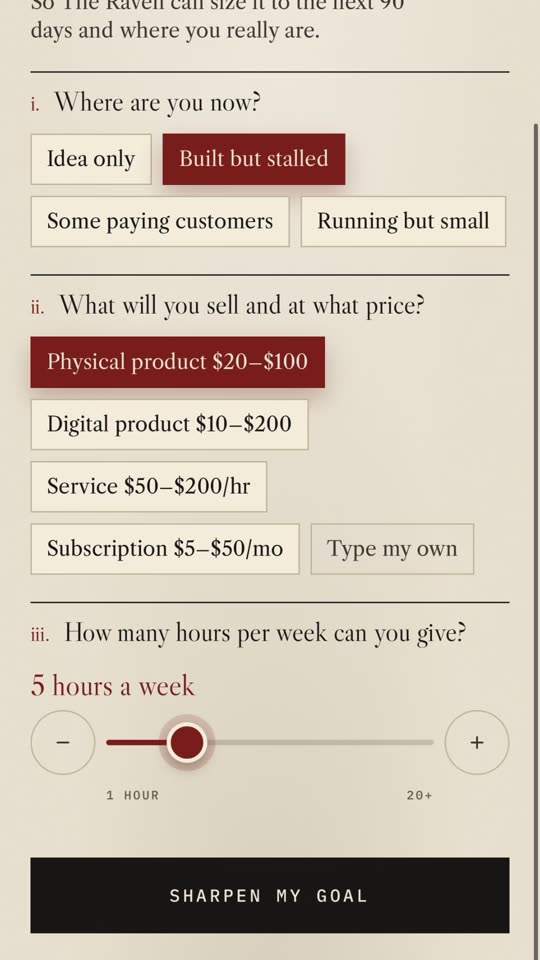
Tell the Raven what you want
It drafts your objectives and milestones. Keep what fits and choose your finish line.

Only got 15 minutes? It still counts
Pick the time you have and your missions are sized to fit. Small days still move the quest.

Break the seal each morning
A fresh envelope of side quests, written for where you are on your path.

Keep what fits today
Swipe through the missions and keep at least one, or write your own.

Do the thing for real
Go do it, then snap one photo of the moment as proof.

Keep the card
Hold the seal and your moment becomes a card. Keep the real photo or let the Raven illustrate it.
Why this one sticks
Other habit apps hand you an empty list. The raven hands you a quest.
Tell the raven any goal
Join 3,240 members who have started a path since launch on October 21, 2026. Build your whole path and see it before deciding on a pass.
$10 USD a month, or $60 USD a year
Build my pathDo the thing. Keep the proof forever.
Every card has a name, a date, a serial number and a rarity, made from a moment someone actually lived. Here is the real photo next to the card it became.

 Real photo

 Real photo

 Real photo

 Real photo

 Real photo

 Real photo
Questions people ask
Do 80 percent of New Year's resolutions really fail by February?
No reliable study says that. The figure comes from a 1989 paper in which about a third of participants were quitting smoking, and the low success number usually quoted is from a two-year followup rather than a six-week one. At six months that same work put success nearer forty percent. The best-controlled study on the question, Norcross, Mrykalo and Blagys in 2002, found 46 percent of resolvers still continuously successful at six months.
Do New Year's resolutions work?
On the evidence, yes, and better than the alternative. The 2002 study compared 159 people who made a resolution with 123 people who wanted a comparable change but did not make one. At six months, 46 percent of the resolvers were still succeeding against 4 percent of the non-resolvers. Making the resolution was associated with being more than ten times more likely to have changed.
What is Quitter's Day?
A marketing term for the second Friday in January, popularized by a fitness company describing when its own users' activity drops off. It is a real pattern in one app's data and it is not a finding from any academic study of resolutions, despite being quoted alongside them constantly.
Why do New Year's resolutions fail?
The usual answer is willpower. The more useful answer is translation. A resolution names an outcome, like get fit or write a book, and nothing in the tradition converts that into what to do on a particular Tuesday. The research supports this shape: specific, measurable, approach-framed goals outperform vague or avoidance-framed ones, and the people who succeeded used concrete behavioral strategies rather than motivation and insight.
When do most people give up on their resolutions?
There is no single moment, which is the most useful thing in the data. Self-reported continuous success declined gradually from 71 percent at two weeks to 46 percent at six months. The decline is a slow leak rather than a cliff, so the belief that it is over after one missed day is both wrong and a significant part of why attempts end.
How many people make New Year's resolutions?
Estimates vary by survey and by year, commonly landing somewhere between a third and a half of adults in the United States. We have not found a single authoritative measurement, and the figures circulating are mostly commercial polls rather than peer-reviewed work, so treat any precise number you see with caution.
Tell the raven your resolution
Name it once and the whole path gets drawn: the objectives, the milestones and tomorrow morning’s first mission. $10 USD a month, or $60 USD a year.
Build my path