 Nevernevermore
 / How to keep a resolution
How to keep a New Year's resolution
The people who kept their resolutions were doing things, not feeling things. Here is what that looks like in practice, from the studies rather than from intuition.
Most advice on this is written from intuition. The research on New Year’s resolutions is small but it is real, and it points somewhere specific and slightly unflattering: the people who kept their resolutions were doing things, not feeling things.
In the 2002 study by Norcross, Mrykalo and Blagys, successful resolvers used more cognitive and behavioral strategies and fewer awareness-generating and emotion-enhancing ones than the people who did not make it. Concrete methods beat insight and intensity. We went through the full evidence, including why the famous failure statistic is wrong, on a separate page.
Six things follow from that, in the order you should do them.
1. Make the resolution, specifically, and say when it starts
This sounds like the trivial part and it is the single best-supported finding in the literature. People who made a resolution were still succeeding at six months at 46 percent, against 4 percent for people who wanted the same change and never made one.
The act of naming a thing and fixing a date does real work that wanting does not. So write it down, in words, with a start date. Not a mood about the coming year.
2. Frame it as something to start, not something to stop
Approach goals outperform avoidance goals. “Walk after dinner” beats “stop being lazy”; “cook twice a week” beats “no more takeaway.”
Part of this is mechanical. An approach goal tells you what to do with the next hour. An avoidance goal only tells you what not to do, which leaves the hour empty and leaves you thinking about the thing you are avoiding.
3. Work out the sequence before January 1
In the study, three things measured before January predicted success: self-efficacy, having the skills to make the change, and readiness to change. Two of those three are about preparation rather than willpower, and both can be improved in December.
So do the translation while it is still December. What does this outcome actually require, what has to happen first, and what is the first real step. Not the first inspiring step, the first one that can be done in an evening.
4. Size the first month to the life you actually have
January 1 plans for a version of you with free evenings and unlimited energy. That person does not report for duty on January 9.
Set the commitment at the level of your average week rather than your best one. The target that survives contact with a bad Tuesday is worth more than the ambitious one that gets abandoned, because the research is about continuous success, and continuity is the thing being measured.
5. Decide now what a missed day means
You will miss a day. The data is unambiguous that this is normal and does not end anything: self-reported success declined gradually from 71 percent at two weeks to 46 percent at six months, with no cliff anywhere in it.
The danger is the interpretation. If a missed day reads as proof that you have failed, you stop, and the stopping is what ends the attempt. Decide in advance, in writing, that a missed day means you do the next one. This is also why we think a streak counter is actively harmful here: it is a machine for turning one ordinary bad day into a verdict.
6. Change the situation, not your attitude to it
The behavioral strategies that distinguished successful resolvers are unglamorous and specific. Substituting one behavior for another. Changing the environment so the right thing is easier and the wrong thing takes effort. Having a plan for the particular situation where it normally goes wrong.
If the gym is forty minutes away, the problem is the forty minutes, not your commitment. Fixing the forty minutes is a better use of January than re-committing.
What to do if you have already stopped
Start again, and do not restart from the beginning.
The cliff is imaginary, so the ground you covered in January is still covered. Most people who fail a resolution one year make the same resolution again, and the relevant question is not whether you broke it but whether the thing you resolved to do is still worth doing.
If it is, the useful move is not more resolve. It is to look at where it actually broke. Was the goal never translated into steps? Were the steps sized for a week you do not have? Did one missed day get read as an ending? Each of those has a different fix, and none of them is trying harder.
Where software helps and where it does not
No app is going to supply readiness to change, and anything claiming to is overselling. What software can plausibly do is the translation and the sizing: turning an outcome into an ordered sequence, and turning today’s step into something that fits the time actually available.
That is what we built Nevernevermore for, and it is the reason there are no streaks in it. If your resolution is already a specific behavior you know is right, you do not need us, and a habit tracker that does not punish you is the cheaper tool.
See it
One goal in. A quest out.
Tell the Raven a goal and it draws your whole path. Every morning, a sealed envelope of side quests sized to the time you have. These are the real screens, start to finish.
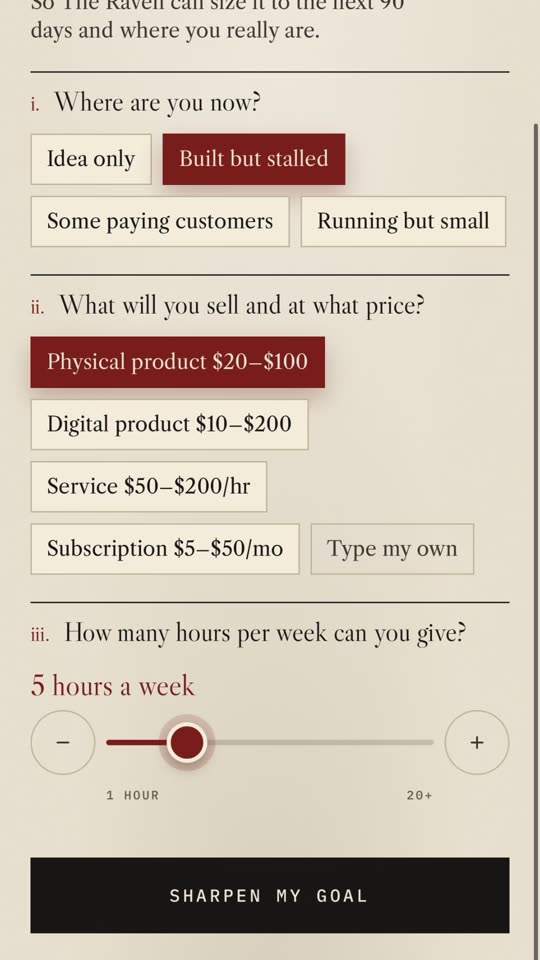
Tell the Raven what you want
It drafts your objectives and milestones. Keep what fits and choose your finish line.
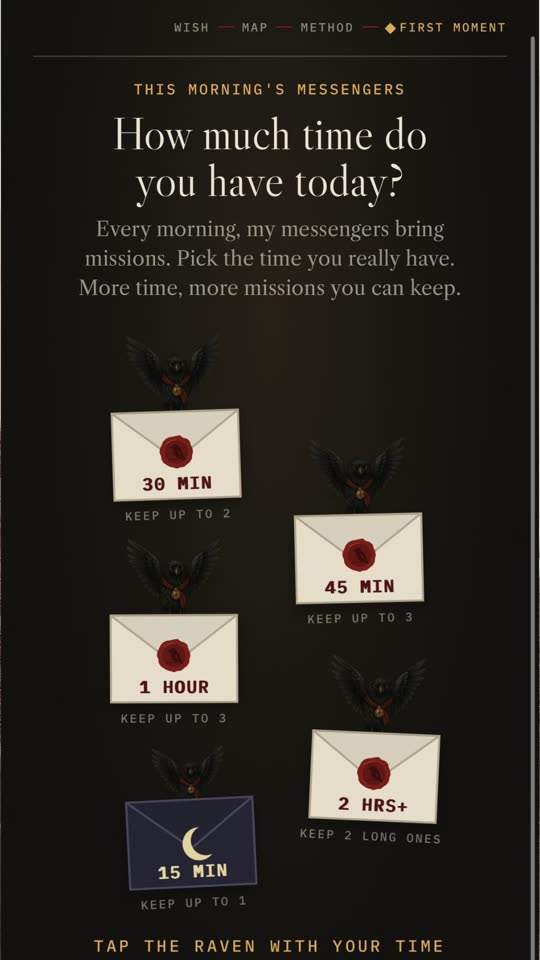
Only got 15 minutes? It still counts
Pick the time you have and your missions are sized to fit. Small days still move the quest.

Break the seal each morning
A fresh envelope of side quests, written for where you are on your path.

Keep what fits today
Swipe through the missions and keep at least one, or write your own.

Do the thing for real
Go do it, then snap one photo of the moment as proof.
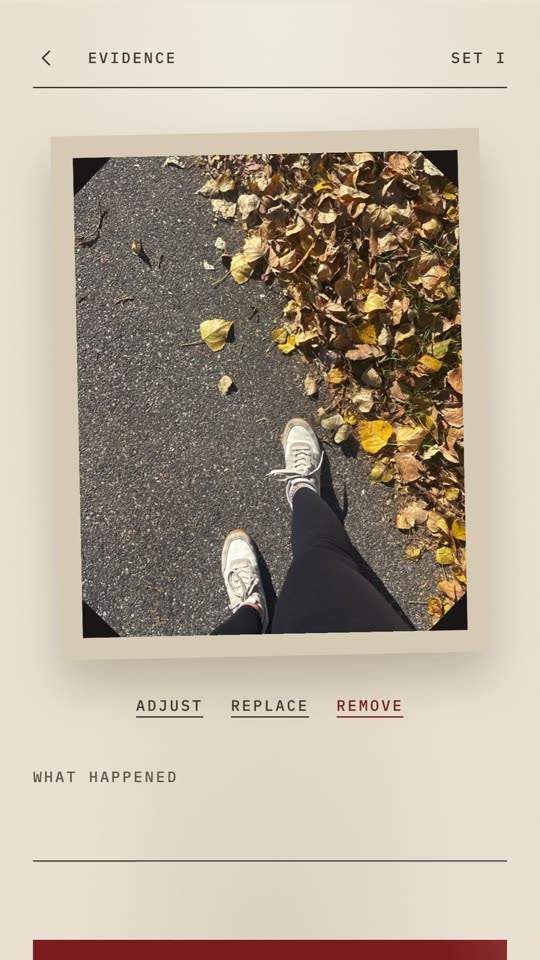
Keep the card
Hold the seal and your moment becomes a card. Keep the real photo or let the Raven illustrate it.
Why this one sticks
Other habit apps hand you an empty list. The raven hands you a quest.
Tell the raven any goal
Join 3,240 members who have started a path since launch on October 21, 2026. Build your whole path and see it before deciding on a pass.
$10 USD a month, or $60 USD a year
Build my pathDo the thing. Keep the proof forever.
Every card has a name, a date, a serial number and a rarity, made from a moment someone actually lived. Here is the real photo next to the card it became.

 Real photo

 Real photo

 Real photo
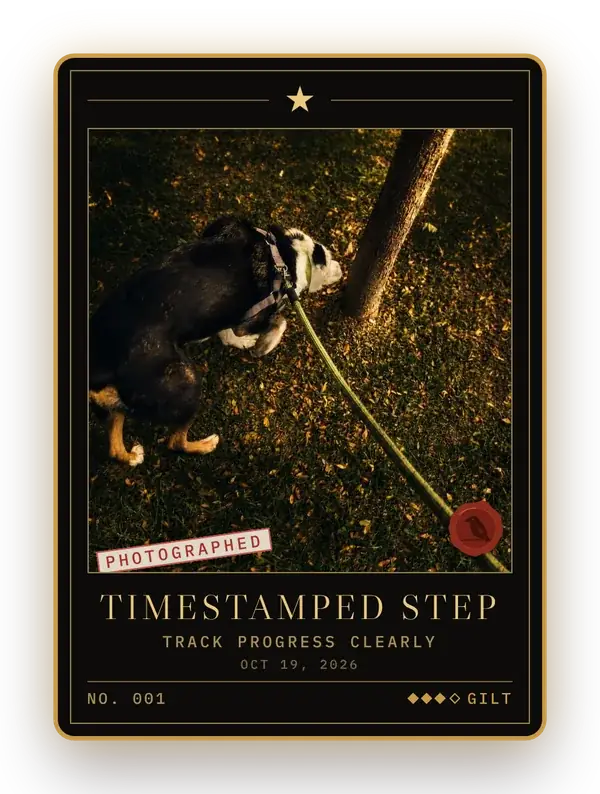
 Real photo

 Real photo

 Real photo
Questions people ask
How do you actually keep a New Year's resolution?
The research points at preparation rather than willpower. Make the resolution specific and give it a start date, frame it as something to start rather than something to stop, work out the sequence of steps before January, size the first month to an average week rather than your best one, decide in advance that a missed day is not an ending, and change your surroundings so the right thing is easier. Successful resolvers used concrete behavioral methods and relied less on motivation and insight than unsuccessful ones.
What is the best way to word a resolution?
As something to start, in specific and measurable terms. Approach goals outperform avoidance goals, and small measurable targets outperform vague ones, so walk twenty minutes after dinner is a better resolution than get fit or stop being lazy. The practical reason is that an approach goal tells you what to do with the next hour, while an avoidance goal leaves the hour empty.
I already broke my resolution. Is it over?
No, and believing it is over is the bigger risk. The evidence shows a gradual decline rather than a collapse at any particular point, so the progress you already made is still real and the attempt is only finished when you decide it is. The useful step is to work out where it actually broke, whether that was a goal never turned into steps, steps sized for a week you do not have, or a missed day read as a verdict.
How long does it take for a resolution to become a habit?
There is no reliable single number, despite the widely quoted figures of 21 and 66 days. The research on habit formation shows a wide range across people and behaviors, and the more useful finding for resolutions specifically is that occasional missed days do not erase the process. Treat any precise day count you see as a simplification.
Should I make one resolution or several?
One, if you are choosing. Each change requires its own attention and self-regulation, and splitting that across several at once makes each less likely to survive. If you have several things you want, sequence them rather than starting them all on January 1.
Does the New Year actually matter, or is it arbitrary?
Somewhat arbitrary, and still useful. What the research supports is the value of naming a specific change and committing to a start date, which a calendar boundary makes easy and socially normal. The same mechanism works on a birthday or the first of any month, so if you are reading this in March, March is fine.
Tell the raven your resolution
Name it once and the whole path gets drawn: the objectives, the milestones and tomorrow morning’s first mission. $10 USD a month, or $60 USD a year.
Build my path