
I'm the founder of an AI goal setting and goal achievement app. It's called Nevernevermore. You tell it a goal and it writes you the whole path. $5 USD a month billed yearly, or $10 USD monthly, no trial, and you watch your actual path get built before anyone asks you for an email address.
So I'm obviously not a neutral party, and you should weigh what I say accordingly. But that isn't why I spent an evening on this. I answered the other app's questions honestly, and what came back bothered me more than I expected it to. If you've ever filled one of these in and believed what it told you, the rest of this is for you.
Keep reading for the proof.
It has been downloaded millions of times. It's built on behavioral science, and it says so everywhere. It talks about psychologists, about research, about data, about habit formation that has been studied properly.
I'm not being sarcastic. That's a genuinely impressive pedigree, and it's the reason a person like me sits down and answers it honestly.
Here's how that goes. It asks you question after question about your sleep, your energy, your stress, how in control you feel, what you're struggling with. Some of them are quite personal. Then it plays a loading bar that says it's creating your personalized plan, and at the end it hands you a profile of yourself: your energy, your well-being, your self-esteem, and the main thing getting in your way.
I have ADHD, and I'm exactly the person these quizzes are built for. I've tried the planners, the trackers, the apps with a checkmark in the icon. So when something with that much science behind it promises to look at my actual life, some part of me still wants to believe it.
I filled it in honestly the first time. Every question, as truthfully as I could manage. Then the screen appeared saying it was building my personalized plan, with three progress bars moving.
And I sat there watching the bars and thought: that's very fast for something that's supposedly thinking about me.
So I did it again. And again.
I didn't want to jump to a conclusion off two attempts. So I kept going.
Why stop at thirty? I wanted to see whether the result would change when I pushed the answers as far apart as they would go. After thirty runs, it still hadn't.
Thirty runs, thirty different sets of answers, changing as much as I possibly could each time. If the plan was responding to anything I told it, surely something would come out different. One number. One line. Anything.
So I did. All thirty of them, as thirty people with nothing in common, answering as differently as I knew how.
Let me just show you what it felt like. This isn't their actual site, I've rebuilt the mechanic here, but picture it. What I told it is my answers. On the other side are the two things it showed me back: the HIGH negative-effects reading from the Well-being Profile, and then the plan screen it handed me afterwards.
The plan screen was identical in all thirty runs. The HIGH reading I captured in twenty-eight of them, because two runs moved past that screen without saving one.
It runs through all thirty on its own. Every one is a different person giving a different set of answers. Just watch what comes back.
One side changes completely. The plan screen never moves. Thirty runs out of thirty, same labels, down to the word.
When you finish the questionnaire, it shows you a before and after of yourself. Now on the left, your goal on the right. Energy low to high, well-being weak to strong, self-esteem low to high, and underneath, the main thing in your way and the goal it picked for you.
That's a fair thing to show someone. Anything worth paying for should be able to show you the with and the without.
The problem is that it's the same before and after for everybody.
Here's a drawing of it. Then the same card from every run I did: someone under twenty who said they were always drained, someone over fifty who answered rarely or never to every struggle, and people who described completely different lives.
This is my own quick drawing of what that screen showed me. It isn't a screenshot and it isn't their artwork.
Thirty runs. Thirty different sets of answers. The same plan screen at the end of every single one.
All thirty plan screens, drawn the same way. Thirty different people, thirty different sets of answers, one result.
After the last question there's a screen that tells you it's creating your personalized plan. Three bars fill up one after the other: setting your goals, selecting strategies, saving your plan.
I timed them. Each bar runs to ninety-five percent in about 1.8 seconds, then stops and waits. The wait isn't loading. It's where the app asks you two more questions and takes your email address. Then the bar finishes.
I've rebuilt that screen below with the same timing, so you can see it for yourself. The counter beside it is the part that matters: it's how many of your answers change a single word of what that page says about you.
I want to be straight with you about one thing rather than overstate it. Information does leave the page while those bars are running. It's the ordinary tracking that almost every website does, mine included. Nothing I could see in those requests was working anything out about you.
There is one message that gets sent with the word "plan" in its name, though, so I went and read what it actually asks for. How much to charge you, in which currency, and whether you have a discount code.
Getting the same answer as everybody else is one thing. This is the part that actually bothered me.
One of my runs was a person in their fifties who answered rarely or never to every struggle on the list. By their own account, a person doing fine.
Here's what they were told about themselves.
The first three are the opposite of what they said. They never mentioned perfectionism either, or calm. Neither did any of the other twenty-nine.
There are two screens here, and that turns out to matter. Before the loading bars, it shows you a screen it calls your Well-being Profile, summarizing your answers back to you. The plan screen comes after, past the bars and a box asking your name.
And then it started disagreeing with itself, which is the part I still find hardest to explain. In eight of my runs the Well-being Profile said my energy was “Normal”, and nine more said “Somewhat low”. The plan screen a few taps later said “Low” in every single one. The app contradicted itself inside the same session.
And the bar above it, the one labelled negative effects? Every single profile screen I captured said HIGH, all twenty-eight of them, including the people who answered rarely or never to everything. Twenty-eight and not thirty because two runs moved past the profile screen without saving one; I have the plan screen for all thirty. That number isn't worked out at all. It sits in the page's settings as a fixed value.
"headerText":"Negative effects level", … "textColor":"#14191D",
"barValue":"77","bar":{ … }
Seventy-seven, typed in once. That's the number behind the HIGH that every single person is shown.
Here's the part anyone can follow, and it's simpler than it sounds.
When the quiz ends, the results screen isn't built out of your answers. It's a separate page with its own web address, like any other page on the internet, and the quiz just sends you to it.
So I found that address in the page's own code and copied it. Then I opened a brand new browser tab and pasted it straight in. I hadn't taken the quiz in that tab. No answers. No email. Nothing.
Because that screen is a fixed file. It was last changed in October and it hasn't thought about anyone since. The labels you read about yourself are typed into it. I even found a note from one of their own developers sitting in the file. Here it is, word for word.
// Portrait pair follows the `gender` answer. Requires the slot's
// exposedAnswerStepIds to list "gender": getAnswers() returns an empty array
// for anything not declared there, so this is a no-op without the config change.
In plain words: the plan screen is handed nothing at all for any answer that isn't on its list. The only quiz answer on that list is gender. The other two values it asks for are pricing flags.
I want to be completely fair here, because exactly one of your answers does reach that page and I should give credit where it's due.
Every question about your sleep, your energy, your stress, how much control you feel over your own week, what you're struggling with, how often you feel drained. All of it collected. None of it changes a word.
And then a picture of a stranger, picked to look a bit more like you, sitting above a verdict about your self-esteem that was typed into a file in October.
I'm not even sure that counts as personalization. It's more like being handed somebody else's profile with a photo picked to resemble you stapled to the front.
At the end there's a discount, reserved for the next fifteen minutes. Reload the page and it's fifteen minutes again, starting from a slightly different number, as though it had been counting down while you were gone.
Then you're asked to pick a gift to reveal your discount, while the discount is already printed on the banner behind the boxes.
Try both.
And then, at the end of all of that, the price.
I should be straight about my own side here, because it would be a bit rich not to be. On my own funnel the price doesn't show up until the end either. Partly because it localizes to wherever you are, partly because that's just how these things get built. That's exactly why I put my number in the first paragraph of this page instead.
The price arriving last isn't the part that made me start checking. A countdown that resets, and a gift box in front of a discount that's already been decided, are a different thing.
Not why the app is imperfect. Everything is imperfect. I find things in my own app every week that I need to go and fix.
What I can't work out is this. With a team of psychologists. With data scientists. With years of behavioral research behind it. With all of that, why is there a number sitting in the page that can't change no matter what a human being types into it?
I want to be careful here, because I can only tell you what I observed. A fixed value in the page, a timer that resets when you reload, and a gift box in front of a discount that's already decided are three things I observed while testing this funnel. I can't tell you why any of those choices were made, or who made them. I can only show you what happened when I tested them, and let you decide what you make of it.
And I should say this plainly, because I'm not standing outside it. I know how this works because it's my job. I'm a marketer. Every business owner alive wants the person in front of them to take the next step, and there's nothing wrong with wanting that. Moving people forward is the whole job. I do it every day.
The line, for me, is whether the information put in front of someone was misleading. Which is a judgment call, and reasonable people will draw it in different places.
Maybe it simply works better this way. That's the part I keep turning over.
The part I can't stop thinking about.
Imagine you're doing okay. You're sleeping well. You feel pretty good about yourself. You answer the questions honestly, because why wouldn't you?
Then a screen says your self-esteem is low.
Maybe you stop for a second. Maybe you think, "Huh. Is it?"
You didn't come in worried about your self-esteem. But now you're wondering whether there's something about yourself you haven't noticed. After all, you just answered all those questions. Surely the assessment came from somewhere.
Except in the flow I tested, it didn't.
The person who answered rarely or never to every struggle got that same result. So did the person who said they were always drained. So did I, when I opened the results page without answering a single question.
It's not just failing to recognize a problem you have. It's telling you that you have a problem you never reported.
And if you're already having a difficult week? If you're tired, overwhelmed, or looking for something to help you understand why things feel hard?
I can imagine how easy it would be to believe that assessment. To think it had found something in your answers that you couldn't quite see yourself.
I can't tell you if anyone walked away feeling worse. I didn't study that.
But I can tell you what that screen does. It takes someone who felt fine, and gives them a reason to doubt themselves.
A self-care app should help you understand yourself better. Not make you believe you've been understood when you haven't.
And definitely not tell you your self-esteem is low, no matter how you answer.
I don't know about you, but when I worked out what had happened, I didn't feel clever for catching it. I felt a bit stupid for having answered honestly. And the longer I sat with it, the more that landed as the real cost. Not the money. The small, quiet lesson that being open with something is naive.
People deserve better than that. Especially the people who are most likely to still be hoping.
This is the one part of the page where I'm selling you something, and then I'll stop.
I built Nevernevermore because every app I tried did one of two things: handed me a prettier checklist, or asked me a page of questions and gave everyone the same answer.
I'm not going to pretend there's nothing in front of it. There's a short walkthrough that shows you how the thing works, because otherwise none of it makes sense. Then it asks you for one goal, in your own words, on whatever timeline you want. Thirty days, ninety, or a date you pick yourself.
After that it asks a couple of real questions. Where you're starting from, and what usually gets in your way. Then it draws the whole path in front of you: the stages, the milestones, the first week. About two minutes, and you can watch it happen.
The difference isn't the number of questions. It's that the answers actually go somewhere. Type a different goal and you get a different path, because the path gets written from what you typed instead of picked off a shelf.
These are captures, not examples I wrote. I ran my own funnel twice on the evening of November 12, typed two different goals, and entered ninety days for both. What you see here is what came back, word for word, trimmed only to the first four stages so it fits on the page. The first thing it did was argue with me about the date, in opposite directions.
Same ninety days typed into both. One it wanted shorter, the other it wanted longer. And in the Japanese run I'd said scrolling and waiting to feel ready were my problems, so two of the four stages came back aimed straight at those.
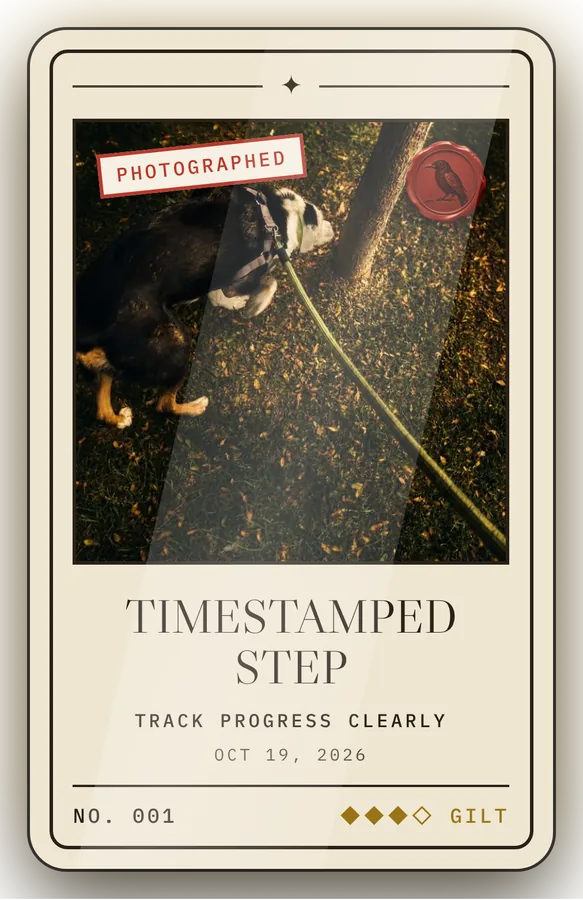
When you have actually done the thing, you photograph it. The mission becomes a card with a name, a date, a serial number and a rarity, and it goes in your Vault.
It's a small thing and it turned out to be the part people mention most. A tick disappears the moment you make it. A card is still there in March.
Keep your real photograph, or have it illustrated. Your choice, every time.
If you've ever had an app history that looks like this, you already know why that matters more than it should.
I want to be straight about what I think the real difference is, because it's not the one you'd expect me to claim.
Any company can build a quiz that gives different answers. If the app in this story wanted to, it could do it next week, and then the thing I spent thirty runs proving would stop being true. A quiz with a few if-this-then-that rules behind it is easy to copy. Any of them could do it in a weekend.
What's hard is the next ninety mornings. You have fifteen minutes, it's a Tuesday, you're tired, and what you need isn't a plan. You already have a plan. What you need is one thing, sized to the fifteen minutes you actually have, that moves the plan you already agreed to.
That's the part Nevernevermore is built around, and it's the part you can't fake with a few rules. There's no list of missions sitting on a shelf somewhere. There isn't a running one, a decluttering one, a learn-a-language one. Every single step you get is written by the AI, for your goal, on the morning you open it.
It rereads where you actually are first: what you finished, what you skipped, what you wrote back to it, how much time you said you have today. Miss three days and the next envelope is sized for someone who missed three days, not for the person you were in January. Tell it you're wiped out and tomorrow gets smaller. Tell it you're flying and it pushes.
That's also the honest reason it costs money. Writing every path and every morning from scratch runs on AI servers, and those cost real money every single day. A fixed list of steps would be nearly free to run. It would also be the exact thing I've just spent this whole page taking apart.
And the wins don't vanish. That was the other half of it for me. I'd tick something off and the second I ticked it, it was gone, so I'd get to the end of a week with nothing to show that any of it had happened. Here every win leaves a card behind, so you can look back and actually see how far you came.
Any goal at all. Learn to swim, finish the manuscript, get the spare room back.
You should know exactly who is telling you this.
I told you I'm a marketer. Here's the rest of it. It's what I've done for most of my working life, running paid media for other people's products. So I know what a reset timer is for. I know what a gift box in front of a fixed discount is for. None of this is a mystery to me, it's my own trade, and I've shipped things I'd build differently now.
I fell in love with psychology the same way the people who built that app did. Behavioral economics, habit formation, the whole shelf. I read it obsessively, then I became a productivity nerd with three planners and a spreadsheet for my spreadsheets.
I love games, so I spent years trying to merge the two. I wrote a hundred page book about it and scrapped it. I built a real-life RPG kit called Life's an RPG with commissioned art and real people filling in character sheets. I've tried to trick my own brain about a million different ways.
Every one of those attempts broke in the same place: the morning. The plan was always still on me.
And no, I'm not a behavioral scientist. I have no lab. There are no psychologists on my team, because there's no team. What I have is about twenty years of being the person those studies are about, and a stubborn habit of reading the actual papers instead of the summary on the landing page.
Here's one I keep coming back to. Researchers at University College London followed people forming new habits and found it took a median of sixty-six days, not twenty-one. And buried in the same work is the finding almost nobody quotes: missing a single day didn't meaningfully affect whether the habit formed.
So the single most common mechanic in this entire category, the streak that resets you to zero the morning you miss, is punishing you for the one thing that study found did not matter much. I can't tell you why any particular app uses streaks. I can tell you what they're very good at, which is making you not want to lose one.
I know that because it's a lever I've pulled myself. It works. That's the problem with it.
The planners. The book. The RPG kit. My life savings poured into projects that people genuinely loved and that I still couldn't make work. Every one of those taught me something that is in this app now.
And I'm not going to promise you my app will change your life. That's the promise I'd make if I were doing to you what was done to me.
Here's the honest version. I'm one person in Honolulu. Thousands of people have joined since October and a lot of them have told me it's the first thing that stuck, and I have those messages. It has also not been for everyone. Some told me what they needed and I changed the app, which made it better for everyone. For others it just didn't work out, and I refunded them.
I run ads. There's a decent chance that's how you ended up on this page. I paid to put it in front of you.
I'm not going to pretend that's not what's happening, because pretending is the whole thing I've been complaining about this entire page. Marketing my own product is what I do for a living.
What I try to do now is narrower and harder: take a product I genuinely believe helps people, and put it in front of them in a way that's actually true. Show the real thing. Say the price. Use a real member's words rather than one I wrote. Make the claim smaller than the product rather than bigger.
I don't always get it right. I've written headlines I later thought were a bit much. I've run things I have since turned off. I'm still learning where the line is between making something sound good and making it sound like something it's not, and I expect I'll keep finding that line the embarrassing way.
That's the one I try not to fail. This page is me trying to pass it in public.
What I care an awful lot about is narrower than changing your life. It's that when something tells you it made a thing for you, it actually made the thing for you. That you can watch it happen. That you can check.
No trial, no gift box, no countdown. You can build your whole path and look at all of it before you type in an email. Following it is paid, because every path and every mission is written from scratch and that costs real money to run. There are no ads in here, so the pass is the only thing keeping it alive.
“The lack of streaks or prizes to lose is why I paid for the app.”
Nevernevermore member“I love how this tricked my brain into thinking something was easier than it was. Then, since I was already doing it, I finished it.”
Nevernevermore memberAny goal at all. Learn to swim, finish the manuscript, get the spare room back.
Not buy my app. Something smaller.
Next time something asks you a long list of questions and then plays you a loading bar, do one thing: take the quiz twice, answering the opposite way. You don't need developer tools. You don't need to know anything technical. Just answer it as someone who is struggling, then answer it as someone who is fine, and read the two results next to each other.
If they're the same, I'd want to know a lot more about what that product actually does.
And if your plan really was built for you, it will survive you checking.
 Nevernevermore