 Nevernevermore
 / New Year's resolution app
The best app for a New Year's resolution
Most apps sold for this assume you already know what to do in January. That assumption is the entire problem. Here is how to pick one, including when the answer is not us.
A New Year’s resolution is a goal with no plan attached. That is the whole problem, and it is worth being precise about it before choosing software, because most apps sold for this solve a different problem entirely.
“Get fit” is a direction. It cannot be done on a Tuesday. Something has to convert it into what specifically to do on January 4th, given the forty minutes that actually exist that evening. Almost nothing in the app store does that conversion. Habit trackers ask you to arrive already knowing the behavior. To-do lists ask you to arrive already knowing the tasks. Both assume the translation is done, and the translation is the thing you came for.
46% vs 4%
Still continuously successful at six months: people who made a New Year’s resolution, against people who wanted the same change and never made one. Resolutions work. The translation is where they break.
Norcross, Mrykalo & Blagys, 2002
We traced that figure and several others to their original papers on a separate page about why resolutions fail, including why the famous eighty percent statistic is wrong. The short version is that making a resolution beats not making one by a wide margin, and the research does not support the idea that it is over by February.
What a resolution app actually has to do
Four things, and most products do one or two of them.
1. Turn the outcome into a sequence
Some things cannot start until other things finish. A resolution to run a half marathon in May has an order to it, and the order is not obvious to someone who has not done it. If the app only stores the steps you typed in yourself, it has not helped with the hard part.
2. Fit the day you are actually having
January 1 plans for a version of you with unlimited evenings. February has eleven minutes and a lot of noise. An app that offers the same block of work every day is going to be wrong most days, and being wrong most days is how it stops getting opened.
3. Survive the missed day
You will miss a day. The research describes a slow decline rather than a cliff, but a streak counter manufactures the cliff anyway: it makes one missed day look like the end of the attempt. Anything built on a number that resets is working against the thing you are trying to do.
4. Leave something behind
A ticked box disappears. A year of them gives you an empty list, which is a strange reward for having changed something about your life. Whatever the app accumulates should be worth looking at in December.
What to use
If you already know exactly what to do
Use a habit tracker, and do not overthink it
If your resolution is meditate daily or read before bed, you have already done the translation. The behavior is identified and correct, and all you need is to remember and repeat it. A habit tracker is the cheapest, simplest tool for that, and several good ones are free.
Pick one that does not punish you for a missed day. We went through which ones handle that well in our roundup of habit trackers without streaks.
If your resolution is really a project with a date
Use a to-do list or a planner
Launch the side business, finish the thesis, get the house sorted before July. If you can write the steps yourself and the difficulty is holding them all and not losing any, then Todoist, TickTick or a planner like Structured will serve you, and they are cheaper than anything that tries to think for you.
If the resolution is real and the plan does not exist
This is what we built, so weigh it accordingly
You name the resolution, at any scale, in your own words. The raven works out the objectives it actually requires, puts them in an order that respects what depends on what, and turns the current step into missions sized to the time you say you have that morning. Eleven minutes is a real answer.
There are no streaks and no counters, so a missed day in the second week of January removes nothing and the next envelope arrives as usual. What builds up instead is a collection of cards, one for each thing you actually did, with the real photo or an illustration. In December you have something to look at rather than an empty list.
It is $10 USD a month or $60 USD a year. There is no free tier, and if the honest answer is that you know exactly what to do and simply are not doing it, one of the options above is the cheaper tool and you should use it.
A resolution is not required to be a year long
Nothing in the evidence says a resolution has to run to December. The calendar is a starting gun, not a contract, and the useful thing about January is the fresh start rather than the twelve months attached to it.
So pick the real horizon. Thirty days, ninety, a date you are working toward. A shorter path you finish is worth considerably more than a year-long one you abandon in March, and finishing something in February is the best available predictor that you will start something else in March.
See it
One goal in. A quest out.
Tell the Raven a goal and it draws your whole path. Every morning, a sealed envelope of side quests sized to the time you have. These are the real screens, start to finish.
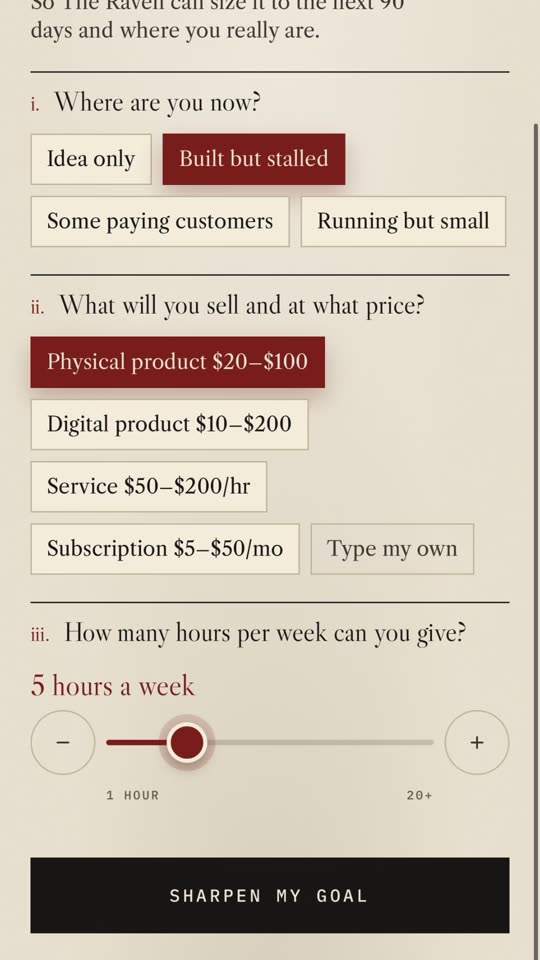
Tell the Raven what you want
It drafts your objectives and milestones. Keep what fits and choose your finish line.
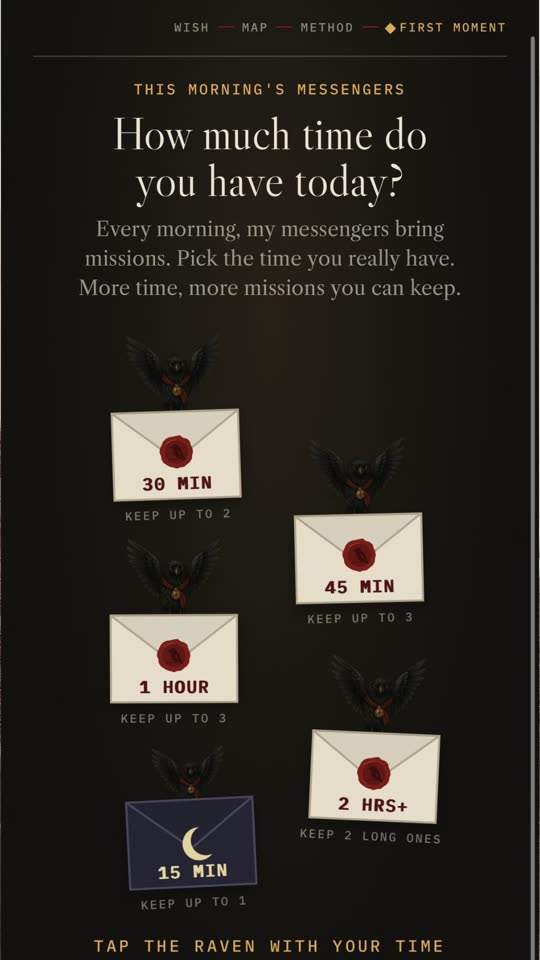
Only got 15 minutes? It still counts
Pick the time you have and your missions are sized to fit. Small days still move the quest.
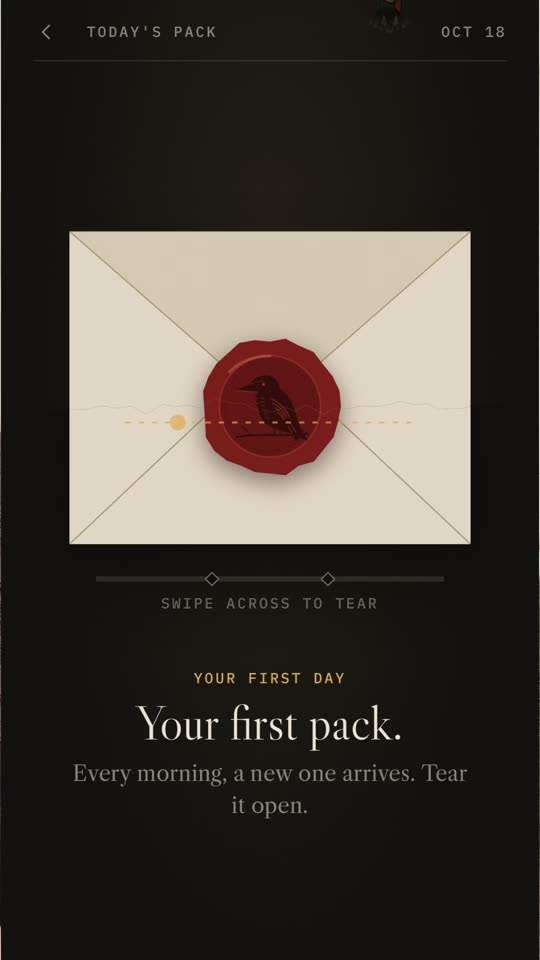
Break the seal each morning
A fresh envelope of side quests, written for where you are on your path.
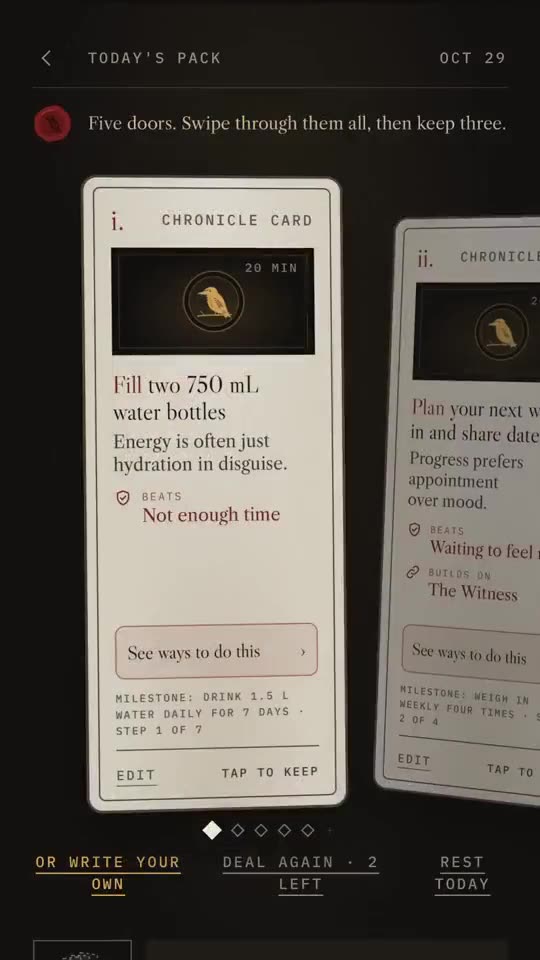
Keep what fits today
Swipe through the missions and keep at least one, or write your own.
Do the thing for real
Go do it, then snap one photo of the moment as proof.
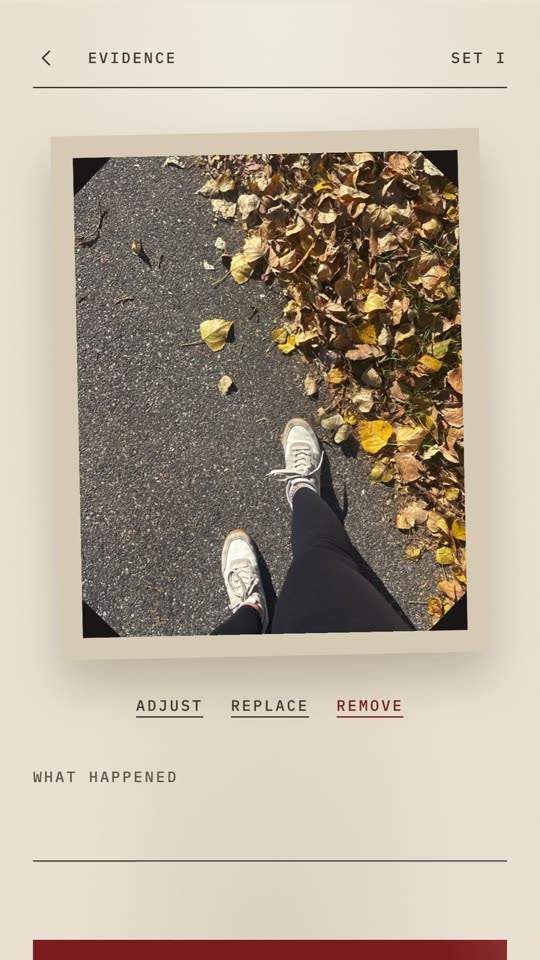
Keep the card
Hold the seal and your moment becomes a card. Keep the real photo or let the Raven illustrate it.
Why this one sticks
Other habit apps hand you an empty list. The raven hands you a quest.
Tell the raven any goal
Join 3,240 members who have started a path since launch on October 21, 2026. Build your whole path and see it before deciding on a pass.
$10 USD a month, or $60 USD a year
Build my pathDo the thing. Keep the proof forever.
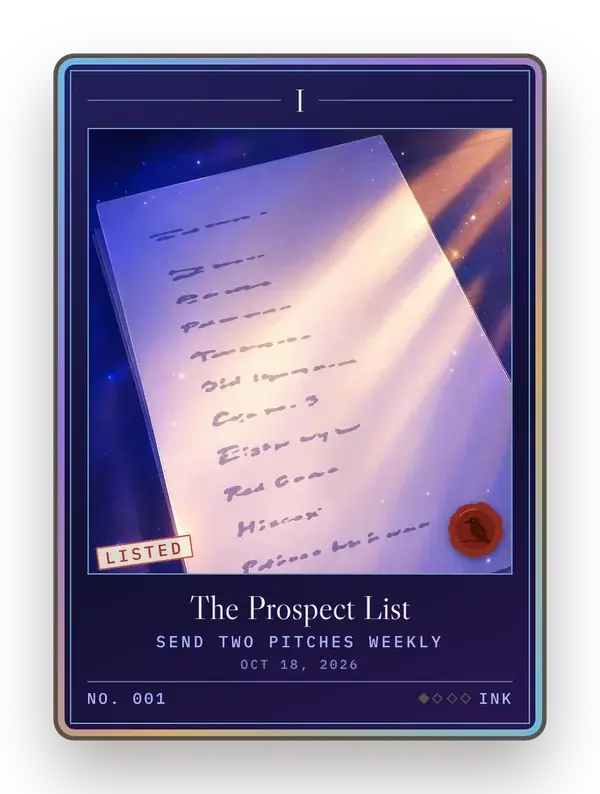
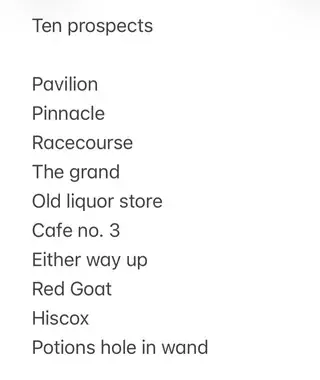
Every card has a name, a date, a serial number and a rarity, made from a moment someone actually lived. Here is the real photo next to the card it became.

 Real photo

 Real photo

 Real photo
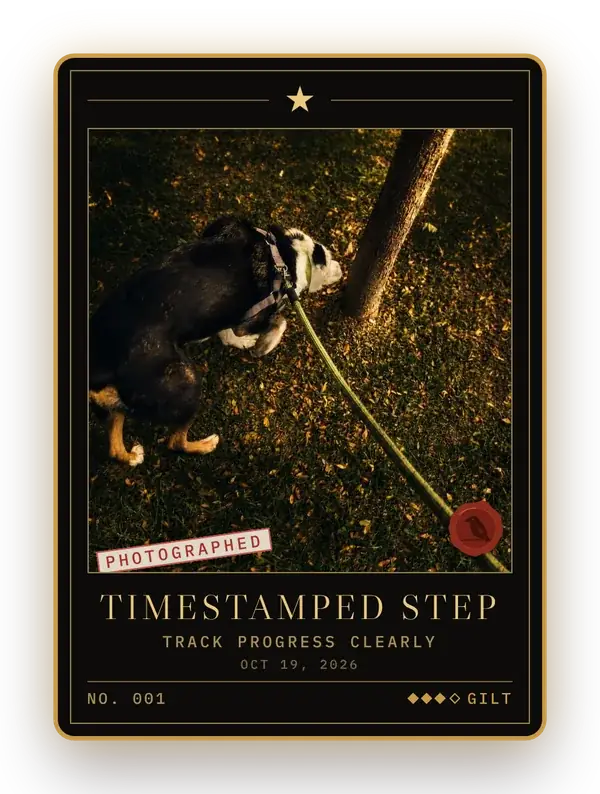
 Real photo

 Real photo
 Real photo
Questions people ask
What is the best app for New Year's resolutions?
It depends on whether you have done the translation yet. If your resolution is already a specific repeatable behavior, a habit tracker is the cheapest tool and several are free. If it is a project you can plan yourself, a to-do list or planner will do. If it names an outcome and you do not know the steps, you want something that produces the objectives and their order for you, which is the category Nevernevermore is in.
Do resolution apps actually help?
The evidence on resolutions themselves is encouraging: people who made one were more than ten times more likely to still be succeeding at six months than people who wanted the same change without making one. There is no comparable evidence that any particular app improves that, and we would not claim it either. What an app can plausibly do is the specific work of turning an outcome into today's actions, which the research suggests is where attempts break.
Should my New Year's resolution be a habit or a goal?
Both, in that order. A habit is the right form for something ongoing that you already know you should do. A goal is the right form when there is an outcome you have not reached yet and the steps have to be worked out. The mistake is picking the habit form first, because then you end up repeating a behavior you guessed at rather than one the goal actually requires.
Is it too late to start a resolution?
No, and the calendar matters less than the research is usually taken to imply. The 2002 study's finding was about naming a specific change and committing to a start date, not about January in particular. A fresh start in March works the same way. The advantage of January is only that everyone else is doing it too.
What happens if I miss a day?
In the data, very little. Success declined gradually rather than collapsing at any single point, which means one missed day is not the end of the attempt unless you decide it is. The practical risk is the belief rather than the day, which is why we removed streaks entirely: a counter that resets to zero is a machine for making one bad day look like a verdict.
How long should a New Year's resolution last?
As long as the thing actually takes. Nothing in the research requires twelve months, and a ninety day path you finish is worth more than a year long one abandoned in March. In Nevernevermore, ninety days is only the default; you can tell it thirty days, a year, or a specific date you are working toward.
Tell the raven your resolution
Name it once and the whole path gets drawn: the objectives, the milestones and tomorrow morning’s first mission. $10 USD a month, or $60 USD a year.
Build my path